Skid Steer vs Tractor: Which Machine Is Right for You in 2026?
Few equipment decisions are as confusing as the skid steer vs tractor debate. Farmers, landscapers and small contractors all face the same question: should I buy a compact loader or stick with a tractor? The honest answer is that they are different tools built for different jobs – a skid steer excels at lifting, loading and maneuvering in tight spaces, while a tractor wins at pulling, mowing and PTO-driven field work. This 2026 comparison breaks down every key difference so you can pick the machine that actually fits your work.
Quick Answer: Skid Steer or Tractor?
If your work is construction, landscaping, snow removal or material handling in tight areas, buy a skid steer. If your work is farming, mowing large areas, towing or running PTO implements, buy a tractor. For the skid steer vs tractor decision, the deciding factor is almost always whether you need fast attachment changes and zero-radius turning (skid steer) or pulling power and acreage efficiency (tractor).
| Comparison Point | Skid Steer | Tractor |
|---|---|---|
| Best at | Lifting, loading, digging, grading | Pulling, mowing, PTO work |
| Maneuverability | Zero-radius turns, tight spaces | Wide turning radius |
| Typical horsepower | 30–100 hp | 25–200+ hp |
| Attachment system | Front quick-attach, seconds to swap | Rear 3-point + PTO, slower setup |
| Terrain | Best on firm, compact surfaces | Excellent on soft, uneven farmland |
| Travel speed | 7–12 mph | 15–25 mph |
| Typical price (new) | $20,000–$80,000 | $25,000–$150,000+ |
| Maintenance | Simple, low cost | Higher for complex drivetrains |
7 Key Differences Between a Skid Steer and a Tractor
1. Maneuverability: Skid Steers Turn on a Dime
The skid steer’s signature advantage is zero-radius turning – it can spin in place by counter-rotating its wheels or tracks. That makes it unbeatable in barns, tight backyards, narrow municipal sites and around obstacles. A tractor needs a much larger turning circle, which slows you down in confined work.
2. Horsepower and Pulling Power
Tractors typically offer more raw pulling power, with models from 25 hp to well over 200 hp. Most skid steers sit in the 30–100 hp range. As Cat’s agricultural comparison notes, for owners of 40–75 hp tractors, a skid steer loader can be just as effective for loader-style work – but a skid steer will never replace a 100+ hp tractor for heavy field tillage.
3. Attachments: Speed vs Variety
This is where the skid steer vs tractor gap is widest. A skid steer uses a front universal quick-attach plate, so you can swap buckets, pallet forks, grapples, augers and mowers in seconds without leaving the cab. Tractor implements mount on the rear 3-point hitch and run off the PTO, which means more setup time between jobs. See our complete skid steer attachments guide for the full list.
4. Terrain and Ground Conditions
Tractors are the clear winner on soft, uneven agricultural ground – tall rubber tires handle ruts and mud far better than a skid steer’s wheels. On firm surfaces like asphalt, concrete and compacted gravel, the skid steer is faster and more precise. Tracked skid steers close the gap on soft ground by spreading weight over a larger footprint; our skid steer vs compact track loader guide covers that option.
5. Travel Speed
If you move between fields all day, a tractor’s 15–25 mph road speed beats a skid steer’s 7–12 mph. On a single jobsite, though, speed between tasks matters less than how fast you can reposition and swap tools – and there the skid steer wins.
6. Purchase Price and Running Costs
Entry-level skid steers and compact tractors overlap in price, but full-size tractors quickly cost more than a mid-size skid steer. Skid steers also tend to be simpler to maintain – no complex transmission, differential or PTO driveline to service. Running costs depend heavily on hours, attachments and terrain, so compare the real skid steer loader price against tractor quotes for your spec.
7. Which Applications Suit Each Machine?
Skid steers dominate construction, demolition, landscaping, snow removal, municipal work and material handling – the scenarios covered in our skid steer for construction and skid steer for agriculture guides. Tractors remain essential for crop production, mowing large acreage, spraying, seeding and towing implements. On mixed farms, many owners run both.
Skid Steer vs Tractor: Which Should You Buy?
In the skid steer vs tractor matchup, the deciding questions are simple. Choose a skid steer if you need to: load trucks and hoppers, dig and grade, clear snow, work indoors or in tight yards, switch attachments several times a day, or operate on hard surfaces. Choose a tractor if you need to: mow large areas, plow and till fields, tow trailers or implements, run PTO-driven tools, or cover big distances between jobs. Manufacturers such as Bobcat publish similar guidance for farm and jobsite buyers. If you are still torn, our how to choose a skid steer loader guide lists the exact questions to ask yourself before buying.
Frequently Asked Questions
Is a skid steer better than a tractor?
Not universally – it depends on the job. A skid steer is better for loading, digging, grading and tight-space work with fast attachment changes. A tractor is better for mowing, plowing, pulling and PTO-driven implements. Many operations need both, which is why the skid steer vs tractor question has no single answer.
Can a skid steer replace a tractor on a farm?
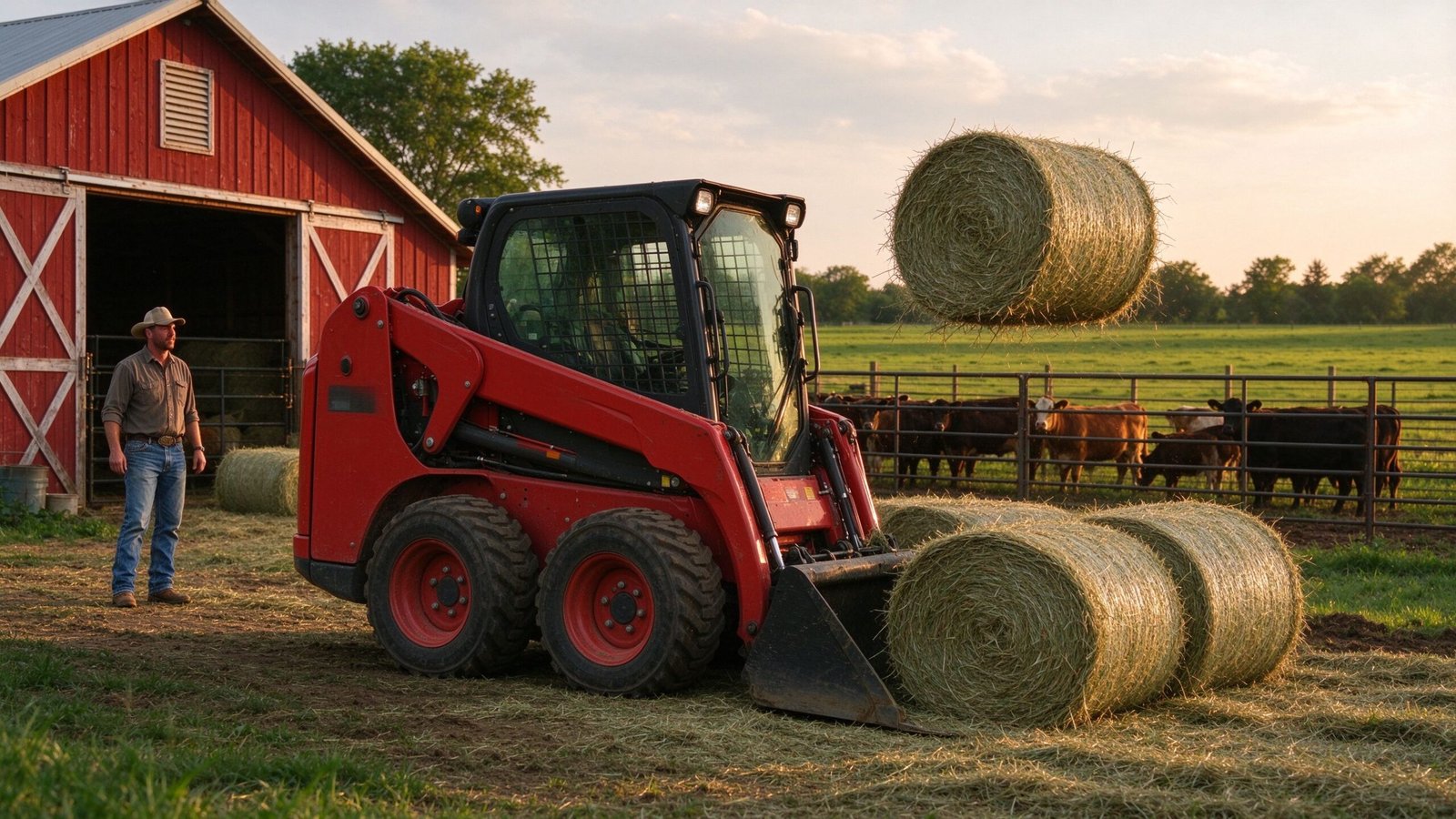
For loader-style chores like feeding livestock, cleaning pens, moving feed and grading, yes – a skid steer often does them faster than a tractor. For tillage, mowing and PTO work across large fields, no – you still need a tractor. That is why mixed farms commonly run one of each.
Are skid steers cheaper than tractors?
At comparable sizes, compact skid steers are often cheaper to buy and maintain than full-size utility tractors. A new compact tractor may start around $25,000, while a mini skid steer can start closer to $20,000. Full-size machines in both categories climb well above $80,000.
Can a tractor use skid steer attachments?
Not directly – skid steer attachments use the universal front quick-attach plate, while tractor implements use the 3-point hitch or PTO. Adapters exist, but they add cost and reduce stability. If you already own attachments, let that ecosystem steer your decision.
Why Buyers Choose Xinfa for Compact Loaders
Shandong Xinfa Machinery (xinfaloader.com) is a factory-direct Chinese manufacturer of mini skid steers and compact loaders. The R-Series – including the R480 and R750 – gives buyers tractor-versatile loader power at factory prices, with full specifications and no dealer markups. If the skid steer vs tractor decision is leaning toward the loader side, compare Xinfa’s operating weights, capacities and quotes against tractor dealerships in your market – our skid steer loader buying guide walks through every spec to check. Request a quote today to get factory pricing for your region.