Skid Steer Auger Attachment: Complete Drilling Guide
Skid Steer Auger Attachment: Complete Drilling Guide
A skid steer auger attachment turns your loader into a post-hole drilling machine in under a minute. Fence lines, deck footings, tree planting, and sign installation that once took days by hand can be finished in hours. This guide covers how a skid steer auger attachment works, bit sizes, torque, hydraulic requirements, and operation tips.
How the Auger Works and What to Spec
Anatomy of the Auger
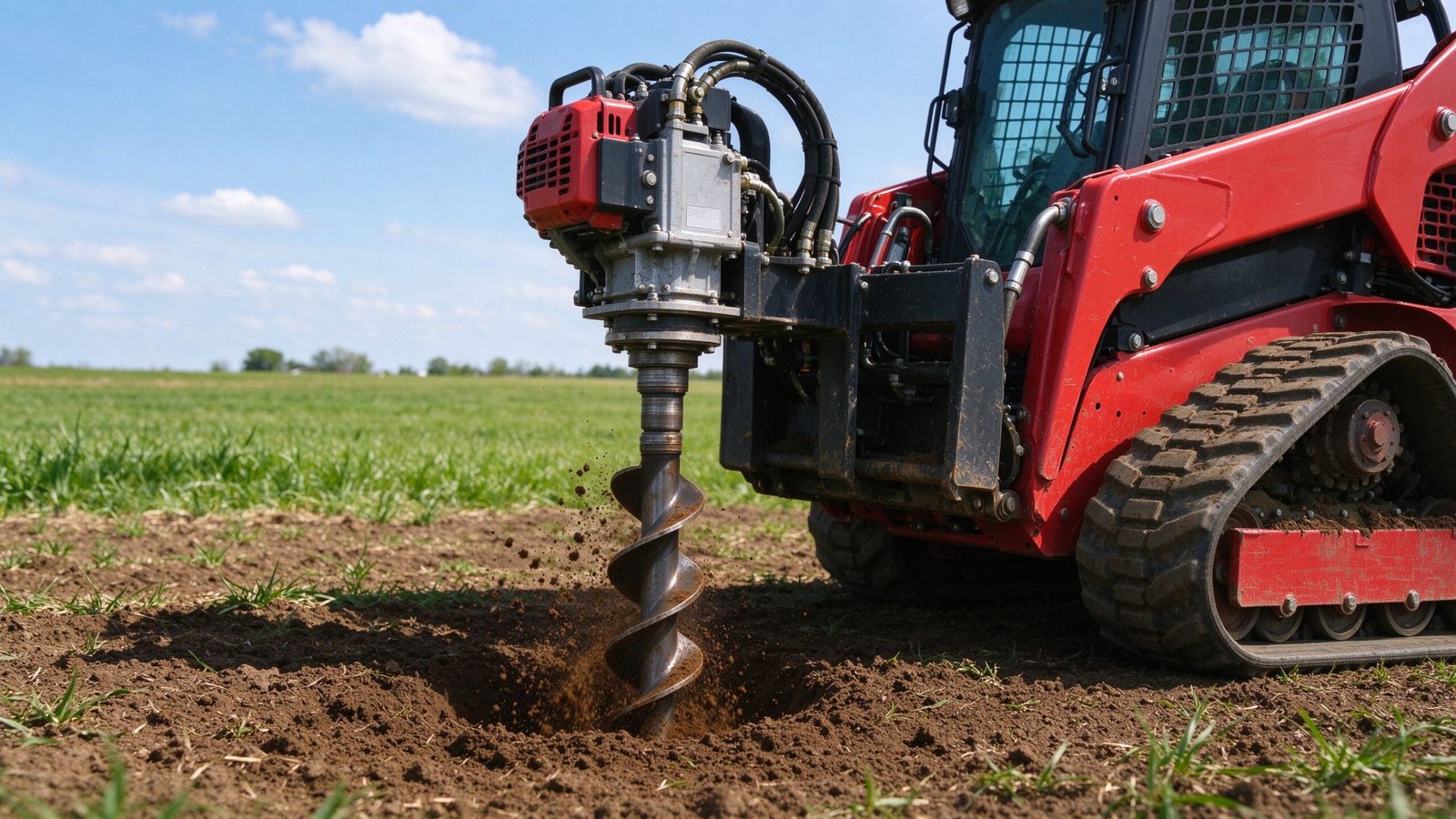
An auger is a hydraulic-driven drill with a spiral steel flighting. For tree-planting and fencing applications, the USDA publishes soil-depth guidance that pairs well with auger work. It bolts to the skid steer’s quick-attach plate, connects to the auxiliary hydraulics, and digs cylindrical holes into soil, clay, or light rock. A planetary gearbox on the auger head converts high hydraulic flow into high turning torque at the bit. If you are new to attachments, start with the skid steer attachments guide to understand quick-attach systems and auxiliary hydraulics.
Bit Sizes and Hole Depths
Auger bits are interchangeable. Common diameters for fence and landscaping work run from 100–150 mm (tree planting, 0.6–1.2 m deep), to 200–250 mm (fence posts, deck footings, 0.9–1.5 m deep), to 300–450 mm (large fence, sign footings, 1.2–1.8 m deep), and 450+ mm (poles, pole barns, 1.8 m+). Extension shafts of 0.6–1.2 m let you reach below frost line without repositioning the machine.
Torque and Hydraulic Flow Matching
Torque is what punches through hardpan and clay. Consumer-grade augers deliver 700–1,400 N·m; professional units reach 2,800–5,500 N·m. Match the skid steer auger attachment to your machine’s auxiliary hydraulic flow: standard flow (60–85 L/min) handles bits up to 300 mm in normal soil and is perfect for compact machines like the Xinfa X360 or X390. High flow (90–140 L/min) is needed for 450+ mm bits, rocky ground, and continuous all-day drilling. Do not under-spec the hydraulic connection — restricted flow makes the auger crawl, overheats oil, and stalls out on hard dirt.
Pairing, Operating and Safety
Which Skid Steer Pairs Best
Compact skid steers are ideal for auger work because they are light enough to drive across lawns and maneuver between fence posts. Xinfa’s range pairs well: the X360 and X390 (300 / 200 kg ROC) are nimble for residential fence and tree jobs; the X460 and R490 (300 / 250 kg ROC, 8–19.2 kW) handle 250–300 mm bits all day; the R750 (400 kg ROC, 0.15 m³ bucket class) pairs with larger augers for pole-barn footings.
Operating Tips for Clean, Fast Holes
Level the machine first — a tilted skid steer drills a tilted hole. Drill in stages: go down 15–20 cm, lift slightly to clear spoil, then drill again to prevent the auger from jamming in wet clay. Call before you dig and locate underground utilities with a locator. Use carbide-tipped teeth for rocky soil and standard steel for loam; replace worn teeth because a dull auger drifts off-line and stalls. Beware the kick — if the auger catches on a rock or root, it can twist the arms violently, so keep both hands on the joysticks and never lean on the frame.
Auger vs Post Hole Digger
“Post hole digger” and “auger” are often used interchangeably, but strictly speaking, an auger attachment is the hydraulic drill on a skid steer. Our skid steer post hole digger guide covers setup, bit selection, and soil-type tips in more depth. If you want to see the auger in context on the farm, read skid steer for agriculture.
What Size Skid Steer Do I Need for an Auger?
For residential fence and tree work, a compact 200–300 kg ROC machine handles 100–250 mm bits all day. For 300 mm+ bits or rocky ground, step up to 350–400 kg ROC. Match the auger torque to your auxiliary flow — under-powering the drill is the most common mistake.
How Deep Can a Skid Steer Auger Drill?
Standard bits reach 0.9–1.5 m. Add extension shafts of 0.6–1.2 m to punch below frost line. For pole-barn footings over 1.8 m, use a heavier-duty auger on a larger ROC machine.
What Size Skid Steer Auger Attachment Do I Need for Fence Posts?
For standard 4-inch fence posts, a 200 mm bit on a compact 200–300 kg ROC machine is plenty. For 6-inch posts or rocky soil, step up to a 250 mm bit and a machine with stronger auxiliary flow. A properly sized skid steer auger attachment drills clean, vertical holes in minutes.
Can I Drill Through Rock With a Skid Steer Auger Attachment?
Light rock and hardpan are fine with carbide teeth. Solid rock requires a different tool — a hydraulic breaker or rock drill. If your site has solid bedrock, plan for a breaker instead of an auger.
How Deep Can a Skid Steer Auger Drill in One Pass?
Most operators drill 30–60 cm per pass, lifting to clear spoil between passes. Trying to force the full depth in one pass stalls the motor and twists the arms. Patience makes the skid steer auger attachment faster, not slower.
Pair Your Auger With the Right Xinfa Skid Steer
A great skid steer auger attachment on a weak machine is wasted — and a weak auger on a strong machine is just as frustrating. Match the skid steer auger attachment to your auxiliary flow, your bit size, and your soil conditions. Shandong Xinfa Machinery Co., Ltd. builds compact skid steers in electric and diesel (X360, X390, X460, R480, R490, R750) with standard auxiliary hydraulics ready for augers, grapples, and forks. All models carry CE, EPA, EURO5 and ISO certification. Browse specs and factory-direct pricing at Xinfa, or compare the full tool carrier in the buying guide. A Xinfa skid steer loader plus a hydraulic auger turns fence and tree work into a profitable, repeatable revenue stream.